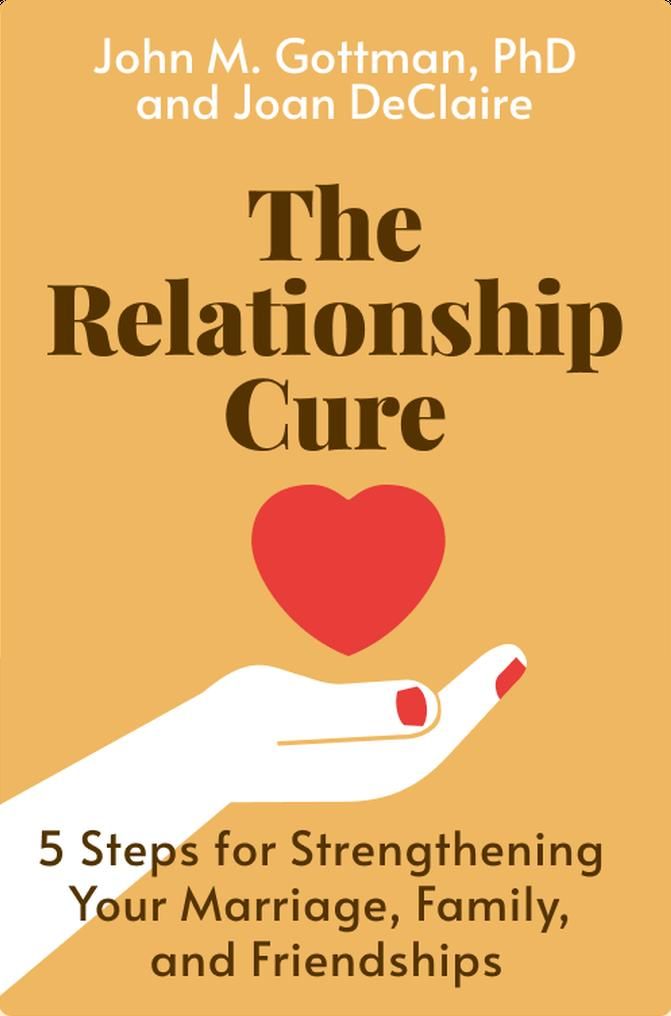
The Relationship Cure
A 5 Step Guide to Strengthening Your Marriage, Family, and Friendships
by John M. Gottman
About this book
The Relationship Cure (2002) prescribes a surprisingly simple solution to the problems that ail many of our relationships. Drawing on psychologist John M. Gottman’s extensive research, its insights and tips are equally applicable to relationships between romantic partners, friends, family members, and coworkers.
Chapter Preview
Chapter 1 of 9People don’t form close relationships by simply “opening up” to each other.
What’s the secret to having a happy, healthy, and close relationship with another person?
If you think it’s a willingness to share your deepest, most personal thoughts, feelings, and experiences, you’re not alone. Back in the early 1990s, many psychologists thought so too – including one of the authors. But then he conducted some research into the matter, and the results surprised both him and many others in the field of psychology.
The key message here is: People don’t form close relationships by simply “opening up” to each other.
In 1990, research psychologist Dr. John Gottman and his colleagues at the University of Washington set up an unusual scientific research center. They called it “the Love Lab.” On the inside, it looked like a normal studio apartment, with a kitchen, dining area, hide-away bed, TV, and waterfront views of a canal. Over the following year, they invited 60 married couples to spend a weekend in this cozy setting. Each couple was given one simple instruction: live life as you normally would.
Of course, there was a catch. The apartment was fitted out with four surveillance cameras and a two-way mirror, behind which observers watched the couples for 12 hours a day. The participants were also rigged with microphones and body sensors that watched for symptoms of stress, like increases in heart rate or levels of sweat.
Dr. Gottman collected hundreds of hours of video footage showing the couples’ everyday interactions in minute detail. He then reviewed the tape, searching for examples of partners baring their souls to one another. But though he looked and looked, he hardly found any instances of what psychologists call “self-disclosure.” Instead, most conversations went like this:
“Honey, could you grab me a cup of coffee?”
“Yes, dear.”
Or:
“Hey, check out this comic strip!”
“Shh, I’m trying to read.”
Pretty mundane stuff, right? That’s what Dr. Gottman thought, too. In fact, he feared the whole experiment had been a waste of time. But then, after reviewing the footage for a few months, he noticed something. The key to forming close relationships was staring him in the face, right there in all those banal conversations.
What mattered wasn’t so much what the couples were talking about, but how they were talking about it to each other. And it’s a lesson that applies to all relationships, whether romantic or otherwise.
8 More Chapters Available
Sign up for free to read all chapters, chat with the book, get personalized recommendations, and more.
Want to read more?
Join BookPulse to access all chapters, chat with books and authors, get AI-powered recommendations, and discover your next favorite read.