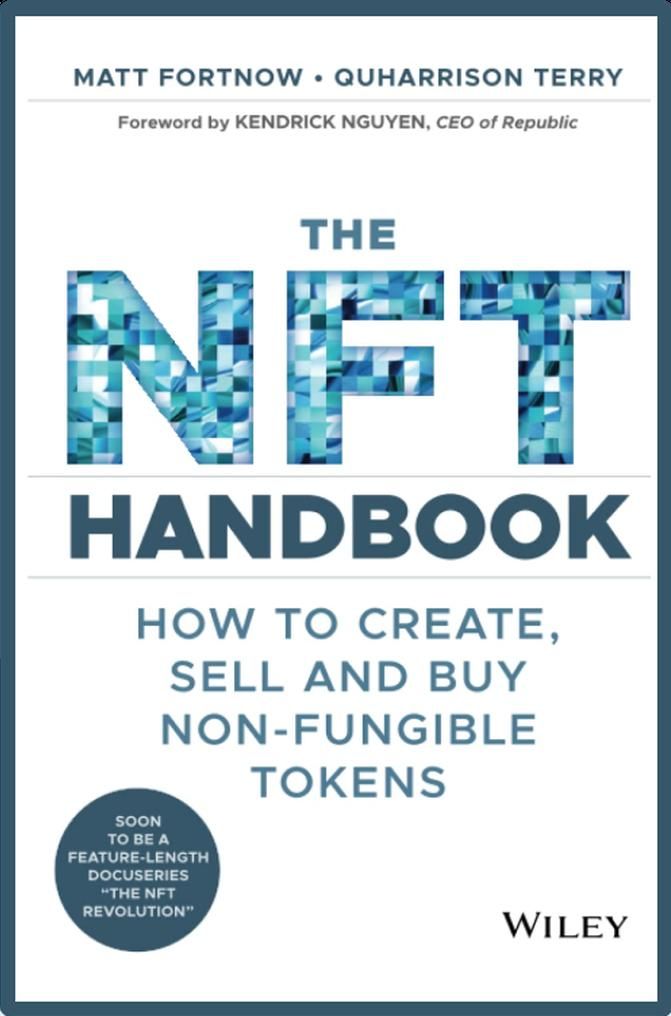
The NFT Handbook
How to Create, Sell and Buy Non-Fungible Tokens
by Matt Fortnow and QuHarrison Terry
About this book
The NFT Handbook (2022) is your go-to guide to “non-fungible tokens” – a new kind of digital asset that’s changing the way we think about ownership in the internet age. Written by two leading experts on NFTs, this explainer covers everything from how NFTs work to how you can enter this booming global market.
Chapter Preview
Chapter 1 of 7A Question of Ownership
Our journey begins in Paris, in the Louvre – the most-visited museum on the planet.
The main attraction for lots of those visitors is an enigmatic portrait in oil on white poplar wood finished around 1500: Leonardo da Vinci’s Mona Lisa.
Currently, insurers value the work at over $800 million.
Where does that number come from – why is this 30-by-20-inch painting so valuable? It’s a deceptively simple question, so let’s break it down.
The first point we can make is that there’s only one Mona Lisa. Sure, we can reproduce the painting as a poster, but even the best reproduction lacks something important.
In the art world, people call that something “aura.” There’s something special about a one-off work. It has a unique existence in the place it happens to be; it’s the only one of its kind. When we hang reproductions of famous paintings on our walls, it just doesn’t feel the same as looking at the originals in museums.
One reason for that is that reproductions don’t have the same provenance. A long line of documentation about ownership lets us trace the Mona Lisa all the way back to the early sixteenth century. We know it’s the work of Leonardo da Vinci, one of the most important figures in the history of Western art. That knowledge gives the original painting great cultural significance.
The tech world uses a different word to describe one-offs. That word is non-fungible.
“Fungible” means that something is mutually interchangeable. A dollar bill is a great example. If you and I have dollar bills and we decide to trade them, nothing really happens. Both bills have the same spending power; no one who accepts dollars for things they sell cares which bill they receive.
The Mona Lisa sits at the other end of the spectrum: it’s extremely non-fungible. If you happen to own the painting, you’re not going to trade it for a poster. Even a high-end forgery isn’t worth much because it doesn’t have the original’s provenance – its well-documented and storied history.
The key point here is that provenance establishes uniqueness. Unique things are, by their nature, rare or scarce. And basic economics tells us that high demand plus scarcity drives value up.
So that’s how we get to that $800 million valuation. Everyone wants to own a culturally significant work that’s literally changed the way we see the world, but there’s only one Mona Lisa. If you can prove that you own the real thing, you’ve got it made. It’s a seller’s market.
But what’s all that got to do with NFTs? Well, it’s a lot easier to establish ownership and provenance – to trace what belongs to whom and who made what – in the analogue world than it is in the digital world. That’s the problem NFTs solve.
6 More Chapters Available
Sign up for free to read all chapters, chat with the book, get personalized recommendations, and more.
Want to read more?
Join BookPulse to access all chapters, chat with books and authors, get AI-powered recommendations, and discover your next favorite read.