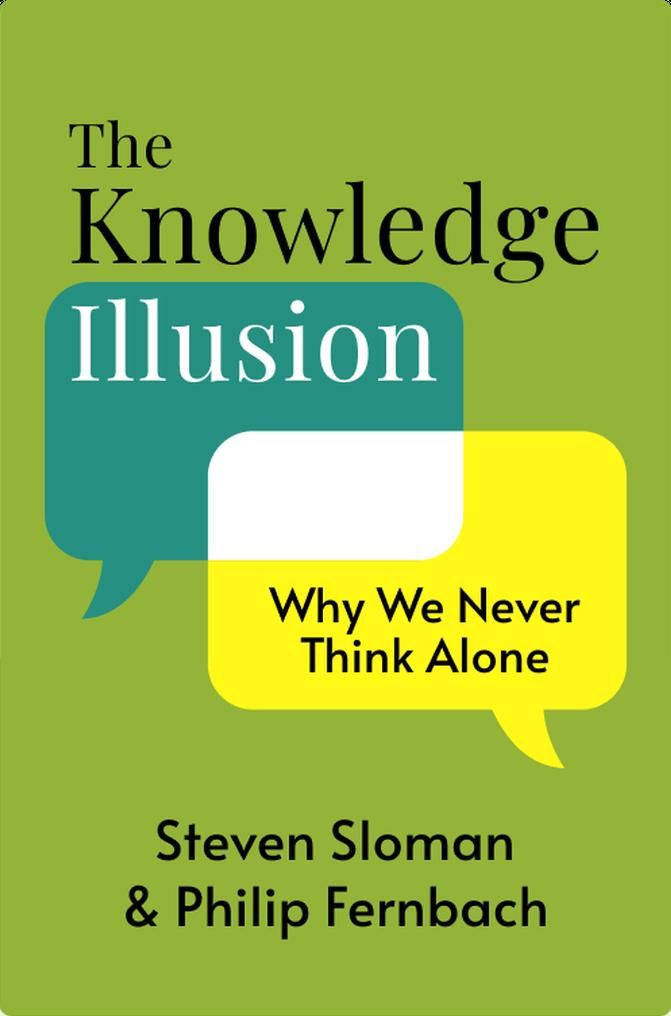
The Knowledge Illusion
Why We Never Think Alone
by Steven Sloman & Philip Fernbach
About this book
The Knowledge Illusion (2017) is an in-depth exploration of the human mind. It argues against the view that intelligence is solely an individual attribute, offering compelling arguments for how our success as a species would have been impossible without a community of knowledge.
Chapter Preview
Chapter 1 of 11The illusion of explanatory depth causes us to think we know more than we actually do.
You can probably ride a bicycle. Most people can – after all, it’s a pretty straightforward activity. Once you master the balance part, simply hop on, push the pedals and off you go. So it stands to reason that you could explain how a bicycle works, right?
Well, you might be surprised. Here’s the thing: people have a habit of overestimating how much they know about how things work, even when they don’t know much at all. This gap between assumed understanding and actual knowledge is called the illusion of explanatory depth, or IoED, for short.
To get an idea of how the IoED works, let’s return to the matter of bikes.
At the University of Liverpool, a psychology professor named Rebecca Lawson put her students’ knowledge to the test by handing out copies of a drawing. It depicted an incomplete bicycle, which lacked, among other parts, a chain, pedals and sections of the frame. She then asked her students to complete the drawing.
The resulting drawings varied in accuracy. One had two sets of pedals; another lacked crucial parts of the frame. Few would have fared well on the open road.
This led the students to an uncomfortable realization: they were unable to articulate knowledge that they’d been sure they possessed, and their understanding was in fact quite shallow. That’s the IoED in a nutshell.
How a bicycle works is just one of many things that people, when put to the test, have difficulty explaining. Other tests have revealed that people overestimate their knowledge of all sorts of everyday objects, from zippers to toilets to wristwatches. Indeed, people tend to overestimate their knowledge of everything.
The inevitable conclusion to be drawn from this fact? People don’t know as much as they think they do.
This leads us to a question that bedeviled early cognitive scientists: how much do we know?
10 More Chapters Available
Sign up for free to read all chapters, chat with the book, get personalized recommendations, and more.
Want to read more?
Join BookPulse to access all chapters, chat with books and authors, get AI-powered recommendations, and discover your next favorite read.