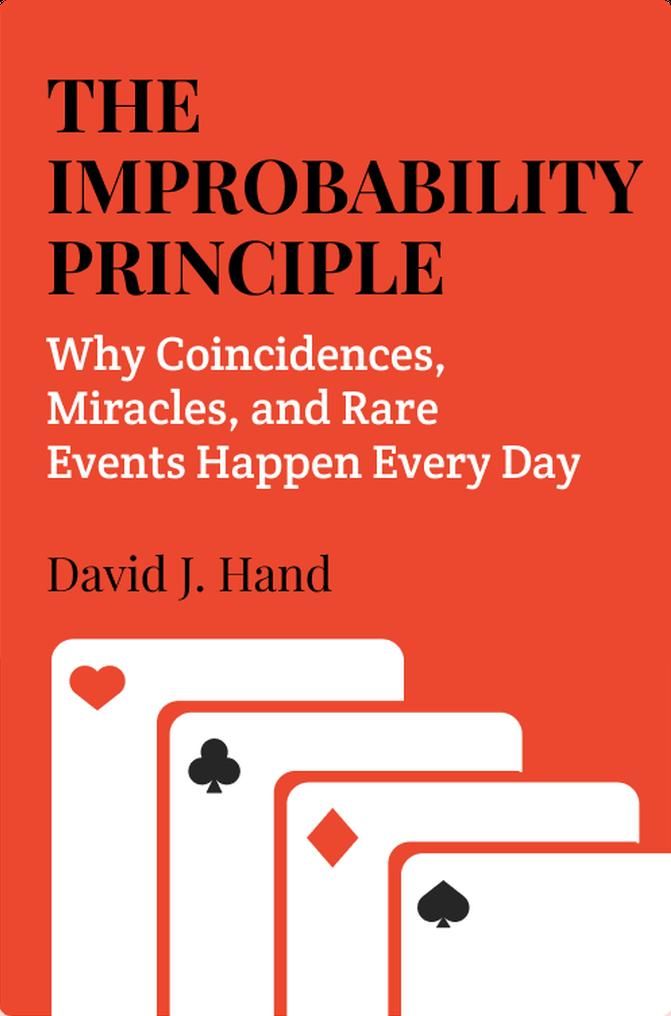
The Improbability Principle
Why Coincidences, Miracles, and Rare Events Happen Every Day
by David J. Hand
About this book
The Improbability Principle illuminates the scientific background of chance and probability. Ultimately it demonstrates that even those events which we would otherwise consider “miraculous” are actually to be expected, as long as we have the right information.
Chapter Preview
Chapter 1 of 8Extremely improbable events are anything but miraculous. In fact, they're commonplace.
Have you ever witnessed an event which seemed so improbable and so unlikely that you had to ask yourself: What were the chances of that happening? One in a million? One in a billion?
And yet, there are many real life examples that suggest that events with vanishingly small probability happen every day.
Consider this strange coincidence from 1972, when the actor Anthony Hopkins was signed to play a role in a film based on G. Feifer's novel The Girl from Petrovka. He traveled to London to buy a copy of the book to study the part, but unfortunately, none of the popular bookstores had a copy.
On the way home, however, Hopkins saw a discarded book lying on the seat next to him in the subway station. That book’s title? The Girl from Petrovka. When Hopkins later told Feifer about this strange occurrence, he learned that he had found the copy that Feifer once lent to a friend who lost it!
The chances of this happening seem dizzyingly small, and yet there are many other such examples:
- A woman from New Jersey won the lottery twice within a few months.
- Liz Denial from Nottingham won a prize every single day from October 2012 until June 2013. These prizes weren’t trivial either, including things like a 37-inch LCD TV, a home cinema system, two Xboxes, a five-star holiday trip to Kenya and ₤16,500 on a TV game show.
- Roy Sullivan, a park ranger in Virginia, was struck by a lightning seven different times and survived.
It’s tempting to look at each example and think that each is nothing short of a miracle. After seeing events of vanishingly small probabilities, we might wonder if the scientific laws of nature and causality occasionally break down. In order to try to explain such rare events, some look to superstition, prophecies, gods or miracles.
Yet, as we’ll see later, we don’t actually need to appeal to the supernatural to explain these highly improbable events.
7 More Chapters Available
Sign up for free to read all chapters, chat with the book, get personalized recommendations, and more.
Want to read more?
Join BookPulse to access all chapters, chat with books and authors, get AI-powered recommendations, and discover your next favorite read.