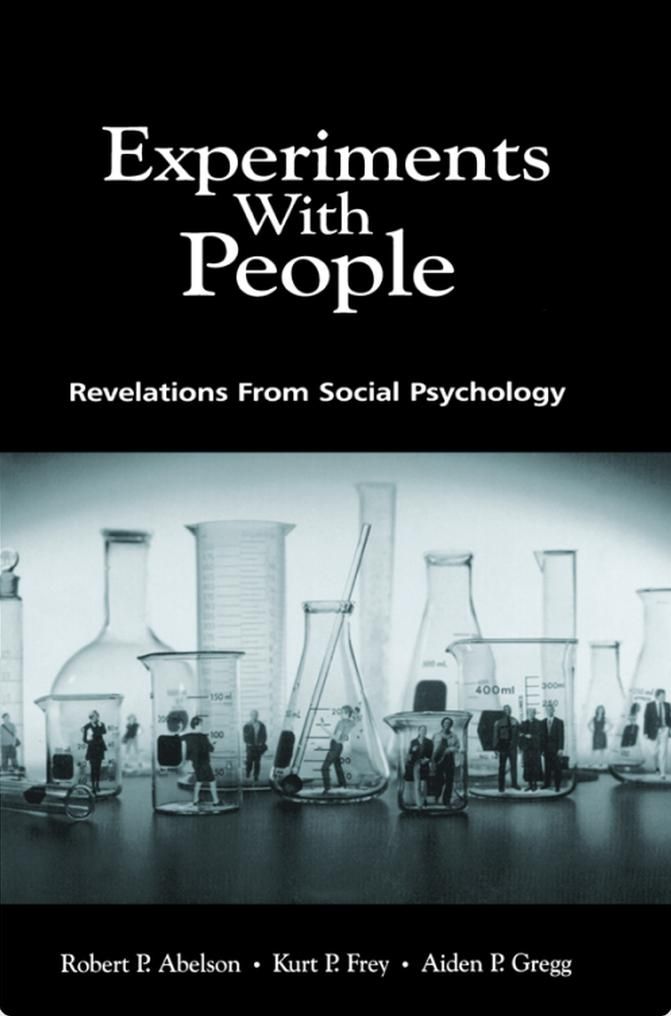
Experiments With People
Revelations From Social Psychology
by Robert P. Abelson
About this book
Experiments With People (2003) is a survey of social psychology throughout the twentieth century, and everything we have come to learn from it. These blinks will teach you about yourself, the hidden sides of human nature, why we make the choices we do and how altruistic humans really are.
Chapter Preview
Chapter 1 of 10People often have misconceptions about their inner lives.
Have you ever screamed at your partner in the heat of the moment, only to apologize later, saying you were stressed out about work?
Well, while you might think that stress explains your behavior, chances are you’re wrong. The truth is that people are much less aware of their inner emotions than they think.
That being said, people often find justifications for their actions by taking a deeper look at their thoughts and feelings. This practice is known as introspection but, unfortunately, it doesn’t work very well. Just take a study done in 1977 by Richard E. Nisbett and Nancy Bellows. In this experiment, participants were asked to rate a hypothetical job applicant named “Jill” based on characteristics like flexibility and likability.
Each participant received a file containing information about Jill, with some files stating that she had recently been in a car accident. Perhaps surprisingly, the experimenters found that knowledge of the car accident had no significant effect on the average likability scores given to Jill by the participants.
However, when the participants were subsequently asked about the factors upon which they based their likability scores – that is, when they were asked to be introspective – they mentioned the car accident as one reason for finding Jill likable. The fact that this self-assessment didn’t match the statistical data shows that introspection can lead us to erroneous conclusions about our behavior.
Beyond that, people just aren’t very good at remembering things. When we have a memory, we don’t just replay a past event; we transform it based on our present beliefs.
A study done by Cathy McFarland, Michael Ross and Nancy DeCourville in 1993 offers a good illustration of this. The participants in this experiment wrote daily reports about their menstrual cycles. Then, when they were asked two weeks later to recall how they had felt, they consistently described having been in more pain and suffering more negative emotions than they actually had.
Why? Most people believe that menstruation is a painful process, or at least supposed to be, and the participants here were no exception. Holding this belief led the participants to retrospectively add more pain to their memories of menstruation.
9 More Chapters Available
Sign up for free to read all chapters, chat with the book, get personalized recommendations, and more.
Want to read more?
Join BookPulse to access all chapters, chat with books and authors, get AI-powered recommendations, and discover your next favorite read.